
MEDICAL PHYSICS, INSTRUMENTATION & TECHNOLOGY IN HADRONTHERAPY

Hadrontherapy is at the forefront of precision oncology, combining advanced physics, engineering, and biology to treat cancer with unmatched accuracy. Innovations in beam delivery, imaging, and treatment planning are expanding the clinical potential of protons, carbon, and helium ions.

Understanding these technological and biological foundations is essential for specialists aiming to optimize patient outcomes and advance next-generation particle therapy.

Pour visualiser cette vidéo, veuillez accepter les cookies

TECHNICAL & BIOLOGICAL ADVANCES IN PARTICLE THERAPY

Particle therapy is revolutionizing cancer treatment by offering precise dose delivery and enhanced biological effectiveness.

Advances in treatment planning, beam commissioning and quality assurance are enabling the transition from protons to heavier ions, like carbon and helium, while exploring innovative approaches such as upright positioning.

Understanding the interplay between physics, biology, and patient setup is essential for optimizing tumor control, minimizing toxicity, and expanding the clinical potential of particle therapy.

TREATMENT PLANNING IN PARTICLE THERAPY

Recent advances in particle therapy planning highlight the growing complexity of transitioning from proton to carbon-ion treatments. Unlike protons, which use a fixed RBE, carbon ions require variable biological modeling influenced by particle energy, dose, and tissue type. Advances in TPS, multi-model optimization, and strategies to boost LET aim to improve plan robustness and maximize tumor control, especially for radioresistant or hypoxic tumors.

COMMISIONING & QA FOR CARBON-ION BEAMS

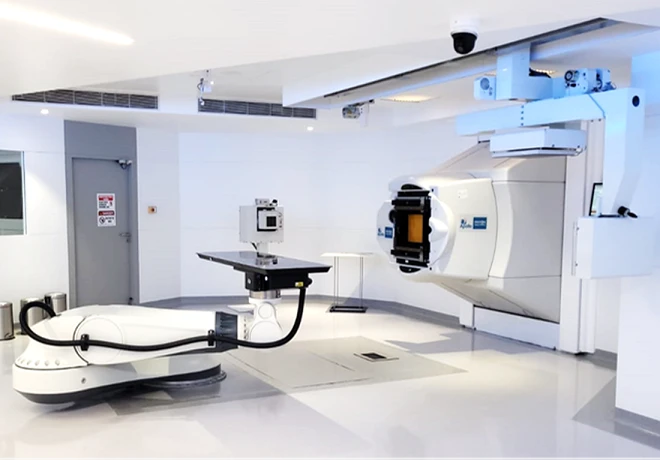
Commisioning and QA of a CIRT facility involves unique challenges compared to proton centers. Carbon beams need precise characterization due to sharp Bragg peaks and complex interactions. Extensive measurements during commissioning establish baseline data for treatment planning and routine QA. Continuous monitoring, combined with Monte Carlo-based software, ensures safe, accurate, and reliable clinical carbon-ion treatments.

HELIUM-ION THERAPY : PHYSICAL RATIONALE AND CLINICAL TRANSLATION

Helium ion therapy, first used in Berkeley in 1957, is being revisited for its precise dose delivery and reduced lateral scattering compared to protons. Clinical development now includes scanned beams, validated biological models, and integrated treatment planning systems. Early compassionate use shows promising tumor control and minimal toxicity. Helium ions offer a middle ground between protons and carbon ions, combining accuracy, biological effectiveness, and potential wider accessibility.

UPRIGHT PARTICLE THERAPY AND IMAGE GUIDANCE

Upright positioning in particle therapy, long used for eye melanoma, is now being explored for broader clinical applications. Advantages include lower cost, compact design, and potential improvements in patient comfort, reproducibility, and dose distribution. Key requirements include vertical CT scanning, image guidance, and TPS capable of handling upright positions. Early studies suggest benefits for thoracic, pelvic, and breast irradiation, as well as proton, helium, and carbon therapies.

BIOLOGICAL MODELS IN CIRT

In CIRT, the biological effect is expressed by RBE, which varies accross the treatment volume and depends on cell type, LET, dose, and other factors. Two main systems exist : The Japanese MKM and the German LEM, both based on mechanistic cell survival models. Clinically validated, they still yield different RBE values for the same dose. Future models should integrate the 5Rs of radiobiology (Radiosensitivity, Repair, Repopulation, Redistribution, Reoxygenation) and intratumoral heterogeneity for more accurate treatment predictions.

KEY TAKEWAYS

  • Carbon and helium ions offer higher precision and biological effectiveness than protons.

  • Commissioning and QA are critical to ensure safe, accurate treatments.

  • Upright positioning can improve patient comfort, reprocucibility, and dose delivery.

  • RBE models are essential for accurate treatment planning.

Pour visualiser cette vidéo, veuillez accepter les cookies

ROUND TABLE - TECHNOLOGICAL STRATEGY FOR PARTICLE THERAPY

Experts discussed current challenges and future strategies for in vivo monitoring and imaging in particle therapy, focusing on PET, prompt gamma, and secondary particle detection. They highlighted the limitations of these techniques due to anatomical uncertainty and emphasized the need for high-quality in room imaging, including vertical CT and dual X-ray systems.

Discussions also addressed workflow integration, adaptative therapy, and selective in vivo dosimetry for high-risk sites.

Watch the full video to hear expert insights on imaging, adaptive strategies, and particle therapy implementation.

Pour visualiser cette vidéo, veuillez accepter les cookies

NEXT-GENERATION CANCER CENTERS

Particle therapy is evolving rapidly, with new centers pioneering carbon-ion treatments alongside established proton therapy.

From Mayo Clinic Florida's phased carbon-ion expansion to UTSW's ultra-personalized adaptive protocols and Caen's compact C400 IONS cyclotron, these initiatives highlight innovations in beam delivery, imaging and workflow optimization, setting the stage for more precise, efficient, and future-ready heavy-ion radiotherapy.

A PHASED PATH TO CIRT AT MAYO CLINIC - FLORIDA, USA

Mayo Clinic Florida's Particle Therapy Center is being designed to deliver both proton therapy and future carbon-ion treatments.

The facility includes a fixed-beam carbon-room, phased expansion potential, and advanced treatment planning with real-time adaptive radiation therapy. Initial indications focus on radiation-resistant tumors, including bone sarcomas, adenoid cystic carcinomas, pancreatic and liver cancers, with potential immuno-oncology applications.

Collaboration with international carbon-ion centers and the use of upright positioning aim to optimize clinical workflow, patient throughput, and future-proof the center for next-generation particle therapy.

ULTRA PERSONALIZATION AT UTSW - TEXAS, USA

UTSW has been advancing ultra-personalized radiation therapy while planning for a future hadrontherapy center.

Despite lacking a carbon-ion beam, the team designed the Hadron Ion Therapy Center with multiple ion sources, gantry options, and in-room imaging to enable flexible, adaptive treatments.

UTSW also integrates online adaptive therapy and AI-driven monitoring to tailor treatment in real time, bridging data from veterinary and human patients to optimize outcomes and advance smart, personalized radiotherapy.

C400 IONS : THE WORLD'S FIRST COMPACT HEAVY ION CYCLOTRON

The C400 IONS radiotherapy system, under installation in Caen by NHa, represents a major advancement in heavy-ion therapy.

This superconducting cyclotron supports protons, carbon, and helium ions, with potential for oxygen, and is designed to make carbon therapy more compact, cost-efficient, and high-throughput.

The Caen facility features two fixed-beam treatment rooms and a third research room, enabling adaptive imaging, carbon FLASH, and multi-ion irradiation . With a foodprint far smaller than traditional carbon centers, the system integrates IBA workflows and dosimetry, TPS compatibility, and flexible patient positioning, including a chair for head and neck treatments.

This innovative setup opens new opportunities for clinical applications, radiobiology, and advanced adaptive protocols.

Pour visualiser cette vidéo, veuillez accepter les cookies

ROUNDTABLE MULTI-ION THERAPY IN CANCER CENTERS

Experts discussed technological advances and future strategies for heavy-ion therapy, focusing on rapid multi-ion switching, ultra-personalized treatment, and adpative fractionation.

They highlighted the potential of carbon FLASH, and AI-driven biomarker integration, while noting challenges in extreme hypo-fractionation, radiobiology, and clinical workflow optimization.

Watch the full video to gain key insights into designing next-generation particle therapy and enhancing patient specific treatment outcomes.

The Symposium Hadrontherapy for Life was recorded in Caen, Normandy – in collaboration with the University of Caen-Normandy, CYCLHAD, François Baclesse Cancer Center, Normandy Hadrontherapy (NHa), Région Normandie and IBA.

The statements of the healthcare professionals included in these videos reflect only their opinion and personal experience. They do not necessarily reflect the opinion of any institution with whom they are affiliated or CYCLHAD.

RBE: Relative Biological Effectiveness, TPS: Treatment Planning System, LET: Linear Energy Transfer, QA: Quality Assurance, CIRT: Carbon-Ion Radiotherapy, LEM: Local Effect Model, CT: Computed Tomography, PET: Positron Emission Tomography, UTSW: University of Texas Southwestern, AI: Articificial Intelligence, Nha: Normandie Hadrontherapy.

Inscription newsletter

Abonnez-vous à notre newsletter pour recevoir nos contenus et événements exclusifs en avant-première !